How much ash will come home from your goat, pig or hen?
Expect roughly 3-5% of body weight[1] back, which for a donkey can mean a heavy box and for a hen barely a handful. Enter a species and weight to see your range.
- Ash weight range from body weight
- Everyday comparisons you can picture
- Honest notes for hens and small birds
Ashes weight estimator
Cremated remains are mostly bone, so they typically weigh about 3–5% of body weight.
Expected ashes
4.5 lb–7.5 lb
That's about the weight of a 5 lb bag of flour.
Source: Embrace Pet Insurance - Bury or Cremate Your Dog? Costs, Pros & Cons
Next step: Get exact prices near you →
Using the estimator
Two inputs and a range you can picture
Choose the species and enter the body weight in pounds or kilograms. The estimator gives a low and high figure for the ashes, and compares it with something familiar, like a bag of sugar or a bowling ball. The type of animal starts on goat, sheep or pig at 150 lb; pick bird for a hen, or horse or pony for a donkey. It updates as you type, so you can try a couple of weights if you're unsure.
Use a healthy adult weight where you can. Most of what comes back is bone, and bone doesn't shrink much when an older goat or ewe loses condition. A weigh tape around the heart girth gives a fair estimate for goats, sheep and pigs.
If you're estimating for a bonded pair cremated together, add both weights. The result is the combined ash you'd receive in one container, which helps if you plan to keep them side by side in a single urn.
The calculation
Where the 3 to 5% figure comes from
Cremation removes water and soft tissue, leaving mineral bone fragments that are processed into the pale, gritty ash families receive. Pet insurers and cremation providers put the result at roughly three to five percent of the animal's body weight, and the estimator multiplies by those two figures. The closest measured benchmark is a study of 100 commercial human cremations, where remains averaged about 3.5% of body weight in adults.
The same math holds at large-animal scale. Our own estimate for a 1,100 lb horse comes to about 38.5 lb[2] of remains, with a plausible range above and below. Farm animals with heavy bone for their size, like donkeys and some sheep breeds, tend toward the upper end. At that size, a unit burning about 250 lb an hour would need at least 4.4 hours[3] for the burn phase alone, by our calculation.
1,500 lb load[4]
For the full process from collection to return, read what happens during farm animal cremation.
Worked examples
What four farm animals return, in everyday terms
| Animal | Body weight | Ashes | The estimator compares it to |
|---|---|---|---|
| Silkie or bantam hen | 3 lb | 1.4 to 2.4 oz | A golf ball |
| Pygmy goat | 60 lb | 1.8 to 3 lb | A bag of sugar |
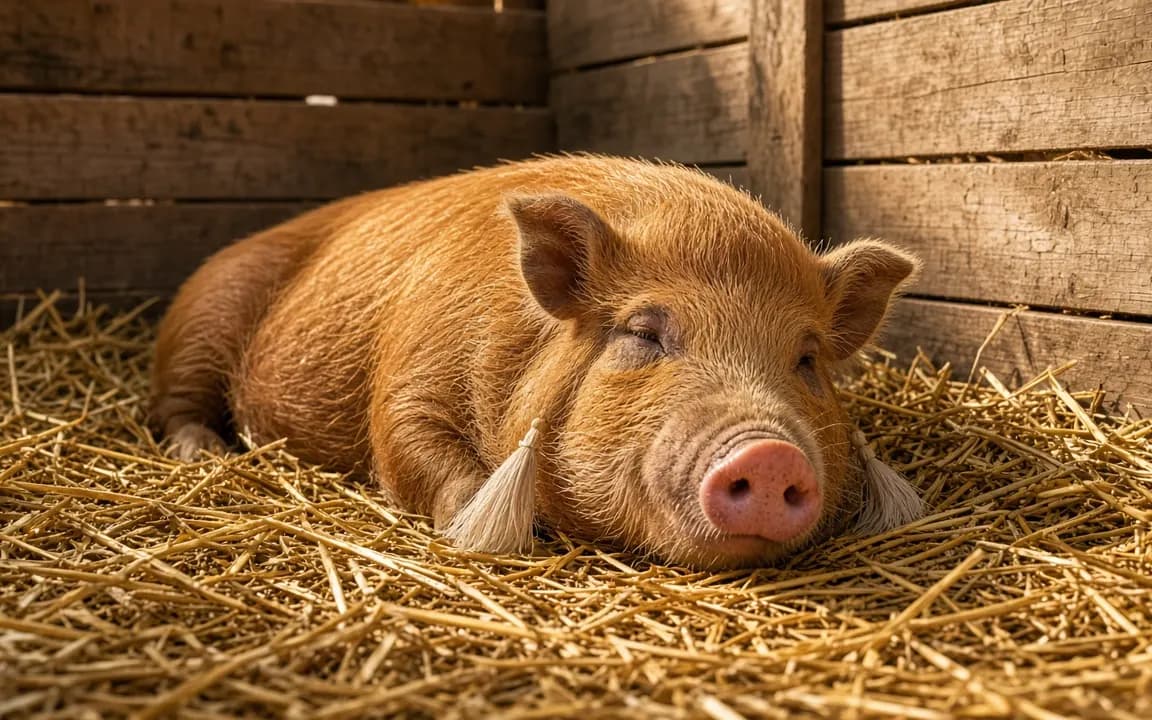
| Pot-bellied pig | 140 lb | 4.2 to 7 lb | A 5 lb bag of flour |
| Standard donkey | 450 lb | 13.5 to 22.5 lb | A bowling ball |
The hen is the result that tends to surprise. The UK has about 900,000[5] pet domestic fowl, and a single small bird returns so little that a standard urn looks empty. Ask for a keepsake-sized container, and make sure the provider offers a genuinely private cremation, since a tiny amount of ash is easily lost in a shared chamber. The fowl figure comes from UK Pet Food's pet population data.
Using the result
What the number means for urns, scattering and sharing
Weight tells you how much you'll have to carry, scatter or share. Volume tells you what urn to buy, and the urn size calculator converts one to the other. As a rough guide, a pound of ash fills about a pint.
If you plan to scatter, a donkey's twenty pounds is a lot to carry across a field, and it's worth planning where it will go. Some families scatter along a favorite fence line and keep a small portion indoors. Ideas for marking the place are in creating a farm memorial corner.

Free tool
Urn size calculator
Find the urn volume you need from your pet's weight, plus keepsake and sharing options.
Would you want your animal's own ashes returned?
Tap an answer to vote and see how others answered. Anonymous.
Know the limits
Why your real amount might differ
- Bone density varies by species, age and breed. Young animals return less; heavy-boned breeds more.
- Processing differs. Some providers grind remains finer than others, which changes the volume more than the weight.
- Communal cremation returns nothing, and a partitioned cremation may return a mix. Only private cremation gives you your own animal's full ashes.
- Very small birds may return less than the formula predicts, because fine bone can be hard to recover.
If receiving all of your animal's ashes matters to you, our comparison of private vs communal cremation explains the paperwork that proves which you received.
Next steps
Planning what comes next
Once you know what to expect, price the cremation itself with the cremation cost calculator. If children in the family want a share of the ashes, our guide to talking with children about losing a farm animal has gentle ways to involve them.
When you're ready, tell us about your animal and we'll find providers near you who offer private cremation for your species and size. Our services page explains private cremation for farm species, our local pages show who works near you, and the poll results show how many keepers wanted ashes back.

Reader polls
What would you choose?
Vote anonymously and see how other readers answered. The results are live counts from people who visit this site, so they show real opinions, not a scientific sample.
Would you want your animal's own ashes returned?
Tap an answer to vote and see how others answered. Anonymous.
Which of your animals are you thinking about today?
Tap an answer to vote and see how others answered. Anonymous.
Where are (or will be) your pet's ashes?
Tap an answer to vote and see how others answered. Anonymous.

Free tools to help you plan

Ashes weight estimator
See roughly how much ash to expect back, by species and body weight.
Urn size calculator
Find the urn volume you need from your pet's weight, plus keepsake and sharing options.

Cremation cost calculator
Estimate a realistic price range for your pet's size, location and the type of cremation.
Questions people ask
How much ash does a goat produce?
Roughly 3 to 5% of body weight. A 60 lb pygmy goat returns about 1.8 to 3 lb of ashes, while a 150 lb dairy goat returns about 4.5 to 7.5 lb. That's enough for a large or extra-large urn, or an urn plus a few keepsakes.
Will I get any ashes back from a chicken?
Yes, with a private cremation, though only a small amount: a 6 lb hen returns roughly 3 to 5 ounces. Make sure the provider offers individual cremation for birds, and ask for a small keepsake container rather than a standard urn.
Are the ashes really just bone?
Mostly. Cremation burns away soft tissue and water, leaving bone fragments that are then processed into a coarse, sand-like powder. Any metal, such as an ear tag clip or a surgical implant, is removed first and may be returned or recycled depending on the provider.
Why do the ashes weigh more than I expected?
Farm animals often have denser bones than pets of the same weight, and donkeys, sheep and older animals can sit toward the top of the range. If the weight surprises you, the provider can confirm it was a private cremation and explain their processing.
How much ash comes back from an alpaca or llama?
An adult alpaca of 120 to 190 lb returns roughly 3.5 to 9.5 lb of ashes. A llama of 250 to 450 lb returns roughly 7.5 to 22 lb, which is more than most pet urns hold. One common approach is to keep part in an urn and scatter the rest where the herd grazes.


Sources and our estimates
- [1] Embrace notes cremated remains typically weigh about 3-5% of the pet's original body weight. Embrace Pet Insurance - Bury or Cremate Your Dog? Costs, Pros & Cons, 2025.
- [2] A 1,100 lb horse would be expected to return roughly 38.5 lb of cremated remains (plausible range 33-55 lb). Our estimate: 1,100 lb x 3.5% (range 3%-5%). How we calculate.
- [3] At an average rate of 250 lb per hour, the burn phase for a 1,100 lb horse would take at least about 4.4 hours, not counting preheating and cool-down. Our estimate: 1,100 lb / 250 lb per hour. How we calculate.
- [4] An animal incinerator sized for agricultural and animal-control use holds up to 1,500 lb per load with a maximum burn rate of 250 lb per hour (manufacturer specification). B&L Cremation Systems (manufacturer) - BLI-1500 Animal Incinerator specifications.
- [5] There are about 900,000 domestic fowl (such as backyard chickens) kept as pets in the UK. UK Pet Food (formerly PFMA) Pet Population 2026, 2026.
Arrange a private cremation near you
Tell us what you need and where you are. We'll reply by email with clear options and prices so you can decide in your own time.