What to say to your child when a farm animal dies
Plain words and honest answers help children more than soft phrases, especially on a farm where they already know some animals end up on the table. In one UK survey, 93.4%[1] of parents wanted better guidance on having these conversations.
By the Farm Animal Cremation Services editorial team · Updated September 24, 2026 · 7 min read · Sources
- Words to use and avoid at each age
- Scripts for predator, guilt and "eaten" questions
- How to explain euthanasia and collection honestly
The short answer
What should you say first when a farm animal dies?
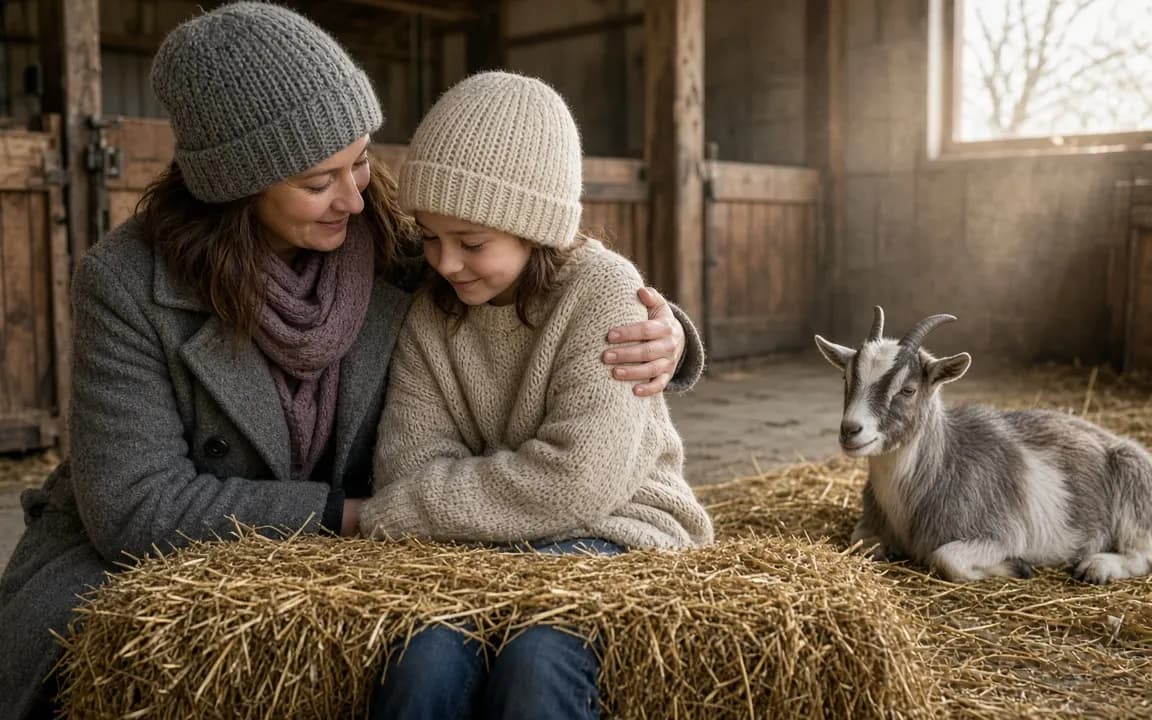
Use the words "died" and "dead," say what caused it in one sentence, and tell your child what happens to the body next. For example: "Daisy died this morning. Her heart was old and it stopped. She isn't hurting, and she's going to be cremated so we can keep her ashes." Then stop talking and let them respond.
Children fill silence with guesses, and on a farm those guesses can be grim. A short, true statement gives them something solid to stand on. You can add detail as they ask for it. This piece covers the conversation itself; for the wider family plan, including chores and viewing, see our guide to farm kids and animal loss.
Word choice
Which words help, and which backfire, at each age?
| Age | Try saying | Avoid |
|---|---|---|
| 3 to 5 | "Clover died. Her body stopped working. She can't eat or feel anything now." | "Put to sleep" (bedtime fears), "we lost her" (they'll want to look) |
| 6 to 8 | "It wasn't anything you did. Goats sometimes get sick inside where we can't see." | "She went to live on another farm" (they'll ask to visit) |
| 9 to 12 | "The vet thinks it was bloat. Gas trapped in her stomach pressed on her lungs." | Vague answers to direct questions; they'll look it up |
| Teens | "Here's what we know, what we don't, and what we have to decide by tomorrow." | "It's just a farm animal" or hurrying them back to chores |
Farm families have a special trap with the "went to live on a farm" line: your child already lives on one. It also teaches them that grown-ups make things up about animals, which makes later questions about the freezer harder. Honest and gentle beats kind and false.
Watch the words adults around them use, too. 34.5%[2] of bereaved owners in the RSPCA's pet bereavement survey said someone told them it was "just a pet." A child who overhears a neighbor call their hen "just a chicken" may decide their sadness is silly. Say out loud that it isn't.
The farm question
How do you answer "Will Daisy be eaten?"
Many farm kids ask this, and it's a sensible question from a child who has watched lambs go to the processor. Answer it directly and early, before they lie awake with it.
- If she's being cremated: "No. Daisy was our pet, not a meat goat. She's going to a crematory, where her body becomes soft ash. We'll get her ashes back in a box."
- If she's being buried: "No. We're burying her deep, in a spot we choose, so no animals can get to her."
- If the body goes to a collector or renderer: "No person will eat her. A company takes animals that die on farms and handles them safely so they can't spread sickness."
- If they ask about the meat animals too: "Some of our animals are raised for food. Daisy never was. That was decided the day she came home."
If you haven't decided on aftercare yet, say so: "We're deciding today, and you can help." It's more honest than guessing, and older kids appreciate being asked. Our services overview lays out each route in plain language.
It can help older children to hear how differently the two worlds count. By our estimate, a sheep or lamb lost on a US farm represents about $200 per head[3] in market value, which is how the industry measures it. Your family measures it in bottle feeds and names, and it's fine to say so.
Foxes, coyotes and open gates
What do you say after a predator attack or a mistake?
Predator losses are common on small farms. USDA figures show predators caused 32.6% of US sheep deaths and 40.1% of lamb deaths in 2019[4]. Children often ask two things afterward: why the animal did it, and whether it was their fault.
For "Why did the fox get her?" try: "Foxes hunt to feed their babies. The fox wasn't being mean, but it's our job to keep the hens safe, and this time we didn't manage it." Children cope better with a predator that's doing what predators do than with a villain. Skip the details of the injuries unless they ask.
For "Was it my fault I forgot to shut the coop?" don't rush to say no if the answer is partly yes; a quick denial can sound like you're covering for them. Instead, try: "Leaving it open gave the fox a chance. You didn't want this and you didn't cause the fox to be hungry. Everyone who keeps animals makes a mistake like this at some point. Let's fix the latch together so it's harder to forget."
Being responsible for a mistake is not the same as being to blame for a death.
If it truly wasn't them, say that plainly and more than once. Young children replay events looking for what they did wrong, sometimes weeks later.
When you chose it
How do you explain euthanasia to a child?
Avoid "put to sleep" with young children. Say what the vet does: "The vet will give Pepper a special medicine that stops her heart. It doesn't hurt. She'll feel the needle, then she'll feel sleepy and her heart will stop. We're choosing it because she can't get better and she's in pain."
Children, like adults, sometimes worry you gave up too soon. Research on bereaved owners suggests that feeling shut out of a euthanasia decision raised grief intensity[5], so include older kids in the conversation beforehand, even if the adults make the final call. You might say: "We asked the vet if medicine could fix it. She said no. So we're deciding how to make her last day peaceful."
- Tell them roughly when it will happen and where.
- Offer them a goodbye first: brushing, a last treat, a photo.
- Let them choose whether to be there, nearby, or back at the house.
- Afterward, tell them it went peacefully if it did. If it didn't, give a gentle version of the truth.
It helps to know ahead of time that animals put down with euthanasia drugs have fewer aftercare routes, because those drugs can harm wildlife that scavenge a carcass. Ask your vet which options stay open before the appointment.
Cremation, burial or collection
What do you tell kids about where the body goes?
Children want to know where the animal is. Give them a destination and a time. For cremation: "A company is coming this afternoon to take Pepper to a crematory. It's a very hot oven that turns her body into ash. We'll get her ashes back in about a week or two." For older kids who ask how it works, our explainer on what happens during cremation is written for adults but reads fine aloud.
Fallen-stock collection and rendering are harder to describe, and some parents are tempted to fudge them. Don't. Try: "A farm collection truck will take her. Animals that die on farms are handled carefully so disease doesn't spread, and they're turned into materials people can use, like fuel." In England, pet goats, sheep and pigs must go through one of 5 approved routes[6] such as a renderer or incinerator, which is useful to know if a child asks why she can't stay on the farm.
How the animal leaves matters to children. In a US survey, 64% reject trash bag[7] of pet owners said a trash bag was an unacceptable container for a body, and kids feel the same. Ask the collector whether you can wrap the animal in a blanket or feed sacks first.

Free tool
Aftercare options compared
Compare private, communal and water cremation with burial on cost, timing and what comes home.
Whether ashes come home changes what you can promise. Compare routes in the aftercare options comparison and read private versus communal cremation before you tell a child they'll get the ashes back.
Would you want your animal's own ashes returned?
Tap an answer to vote and see how others answered. Anonymous.
The weeks after
What if your child keeps asking the same questions?
Repeat questions are normal, not a sign that your first answer failed. Young children often ask "Is Daisy still dead?" for weeks as they test whether it's permanent. Give the same calm answer each time. Older children may come back with sharper questions once the shock wears off: "Could we have caught it sooner?" Answer honestly, including "I don't know" when you don't.
Share your own feelings in small doses. "I miss her at milking time" gives a child permission to miss her too. If you're finding it hard yourself, our piece on adult grief after losing a farm animal may help, and anticipatory grief is common: 75.4%[8] of owners in one survey felt it before their pet died.
When you're ready to arrange aftercare, tell us about your animal and we'll email options from providers near you. You can also see how other keepers answered in our reader polls. Our local pages list providers near you, and live answers are on the poll results page.

Reader polls
What would you choose?
Vote anonymously and see how other readers answered. The results are live counts from people who visit this site, so they show real opinions, not a scientific sample.
Would you want your animal's own ashes returned?
Tap an answer to vote and see how others answered. Anonymous.
Who made (or will make) the aftercare decision in your household?
Tap an answer to vote and see how others answered. Anonymous.
What helped you most in the first weeks?
Tap an answer to vote and see how others answered. Anonymous.


Questions people ask
Should I use the word "dead" with a three-year-old?
Yes. It sounds blunt to adults, but small children understand concrete words better than gentle ones. Pair it with a simple explanation of what dead means: the body has stopped, the animal can't eat, feel cold or hurt. Softer phrases like "passed away" or "lost" can leave a young child waiting for the animal to come back.
What if my child asks whether our other animals will die too?
Be truthful and reassuring at once: "Yes, all animals die one day, but most of ours are healthy and we'll look after them." If the death was contagious, such as bird flu in a flock, explain what you're doing to protect the others. Children worry less when they can see the adults taking practical steps.
How do I explain why we can't bury the goat on our own land?
Keep it about safety, not rules: "The ground here isn't right for a big animal. It could affect the water we drink, so the law says she has to go somewhere else." Burial rules vary by state and county in the US, and in England pet goats can't be buried on the farm at all. Check locally before promising a grave.
Is it okay to cry in front of my kids about a farm animal?
Yes. Seeing a parent sad and still able to do the evening chores shows children that grief and normal life can sit side by side. Name the feeling so they don't have to guess: "I'm crying because I miss Daisy." What unsettles children is feeling they need to look after you, so keep the adult worries for other adults.
My teenager seems angry, not sad. What should I say?
Anger is a common form of grief, especially after a predator loss or a euthanasia decision a teen didn't agree with. Acknowledge it without arguing: "You're angry we didn't call the vet sooner. That's fair to feel." Then give them something practical, such as repairing the fence or choosing the memorial, where that energy has somewhere to go.
Should siblings be told together or separately?
Tell them together if you can, so no one hears it secondhand, then check in with each one alone later. The child who raised the animal will usually need more time than a sibling who barely fed it. Don't compare their reactions out loud; a younger brother's shrug isn't a lack of love.


Sources and our estimates
- [1] 93.4% of parents in the RSPCA survey wanted better guidance on helping children through pet loss. RSPCA — Pet Loss Survey Results, 2026.
- [2] 34.5% of bereaved pet owners were told 'it's just a pet'. RSPCA — Pet Loss Survey Results, 2026.
- [3] The average value lost per dead sheep or lamb in 2019 was about $200; for goats and kids in 2015 it was about $139. Our estimate: $121.6 million / 607,000; $69.6 million / 500,000. How we calculate.
- [4] In 2019, 6.8% of U.S. sheep inventory and 12.0% of the lamb crop were lost to death; predators caused 32.6% of sheep losses and 40.1% of lamb losses. USDA APHIS NAHMS - Death Loss Trends in the U.S. Sheep Industry: 1994-2019 (Sheep Death Loss 2020, published June 2022), 2019.
- [5] In the 2025 euthanasia-and-grief study, grief intensity rose with feeling excluded from the euthanasia decision by the vet and with regret over euthanizing too early; perceived emotional support from the veterinary team was linked to less guilt. 'Euthanasia and prolonged grief: A cross-sectional study with bereaved pet owners', Journal of Veterinary Behavior 79:60-67 (2025), Univ. of Lisbon research portal, 2025.
- [6] England's approved routes for fallen stock are knackers, hunt kennels, maggot farms, incinerators and renderers; the not-for-profit National Fallen Stock Company runs collections for farmers and horse owners. GOV.UK (Defra/APHA) - Fallen stock guidance, 2024.
- [7] 64% of US owners rated a trash bag as an unacceptable container for a deceased pet; 66.1% rated a blanket/shroud acceptable. Cooney, Kogan, Brooks, Ellis - Pet Owners' Expectations for Pet End-of-Life Support and After-Death Body Care, Topics in Companion Animal Medicine (2020), 2020.
- [8] 75.4% of RSPCA pet-loss survey respondents experienced anticipatory grief before their pet died. RSPCA — Pet Loss Survey Results, 2026.
Find aftercare you can explain to your kids
Tell us what you need and where you are. We'll reply by email with clear options and prices so you can decide in your own time.