Every aftercare option for a smallholding animal, side by side
Communal cremation can be 2x to 5x cheaper[1] than a private one for the same weight, and for a 200 lb pig that gap is real money. Here's what each route involves, so you can pick the one that fits your animal and your budget.
- Private, communal and fallen-stock routes compared
- Collection from the barn, field or pen
- Honest notes on burial and composting rules
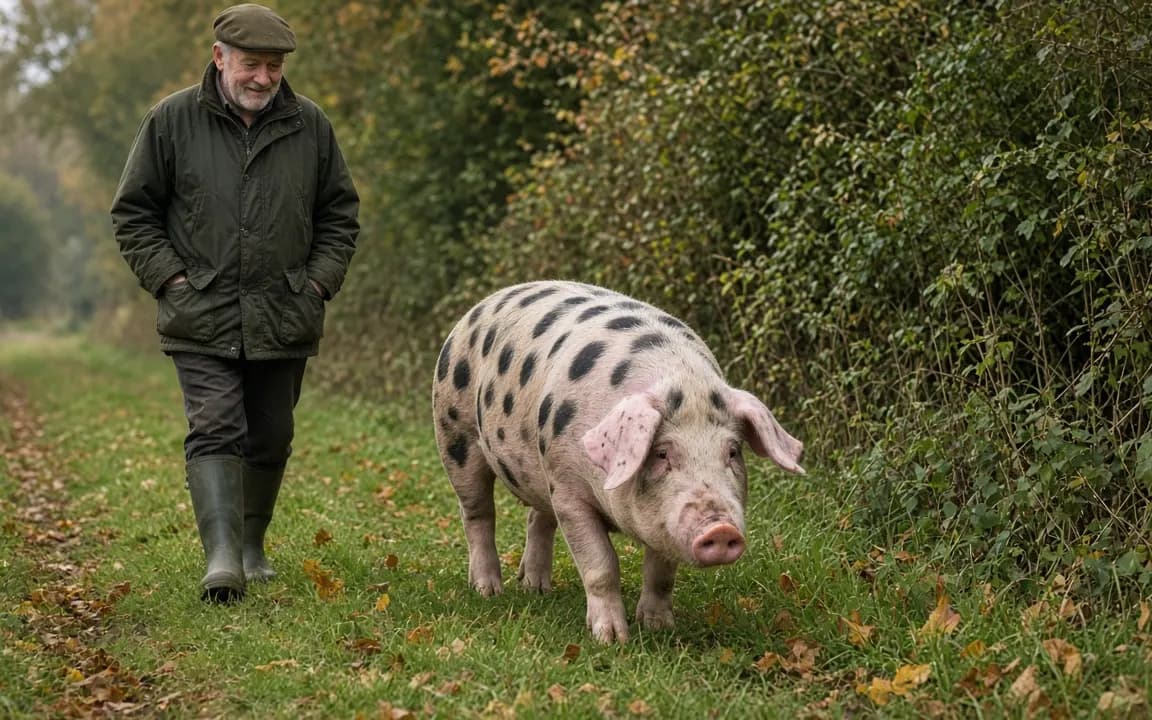
Ashes returned
Private cremation: your animal alone, ashes home
In a private (individual) cremation your goat, sheep, pig or alpaca goes into the chamber on its own, and everything that comes out is theirs. It's the only route that gives you ashes you can be sure of, and it's what most people with a named animal choose.
The catch is capacity. Many pet crematories are built for animals under about 150 lb. A pygmy goat or a hen is easy; a 250 lb kunekune boar or a llama needs a larger chamber, often at an equine or large-animal crematory, and there may be only one within a long drive. That's why price tends to jump rather than climb smoothly above the size of a big dog.
communal $30-200; private $100-500+[2]
Ask whether the provider offers a witnessed cremation if you want to be present, and whether you can send a halter, a blanket or a handful of hay along. Our explainer on what happens during farm animal cremation covers the steps from loading to return.
Lower cost, nothing returned
Communal cremation for goats, sheep and poultry
Communal cremation means several animals share the chamber and no ashes come back. The remains are usually scattered or buried in the provider's grounds. For a smallholder who wants a respectful end without an urn, it's a sensible choice, and it's often the only affordable one for a bigger animal.
Some providers offer a middle option, sometimes called partitioned or segregated, where animals share the chamber but are kept apart. The ashes you receive are mostly your animal's, but you can't be certain they're only theirs. Our comparison of private vs communal cremation for farm animals explains how to tell which one you've been sold.
Would you want your animal's own ashes returned?
Tap an answer to vote and see how others answered. Anonymous.
Getting them there
Farm collection: what the crew brings and what you pay
A dog can go in the back of a car. A 180 lb ewe lying in a wet field can't. Farm collection is often the biggest line on a quote after the cremation itself, and it varies more than anything else: by distance, by how close a vehicle can get and by what lifting gear is needed.
- Vehicle access. Can a van or pickup reach the animal, or is it at the bottom of a muddy slope? Say so on the phone.
- Lifting gear. Larger animals need a winch, a slide board or a tail-lift. Ask whether the crew brings one or expects you to help.
- Mileage. Rural providers usually charge per mile beyond a base radius. Ask for the figure, not just 'mileage applies'.
- Timing. Weekend and after-hours callouts cost more. In hot weather they may still be worth it.
If you have a trailer and help, delivering the animal yourself often saves the whole collection fee. Our page on transport and logistics covers safe ways to move a heavy animal without hurting yourself.
Hens, ducks and geese
Backyard poultry: small birds, different questions
The UK alone has about 900,000[3] domestic fowl kept as pets, and a named hen can be as loved as any cat. Cremating one is simple for most pet crematories. The questions are different: whether there's any disease risk, and whether a bird that small returns enough ash to keep.
A 5 lb hen returns only a tablespoon or two of ash. Many keepers choose communal cremation and keep a few feathers instead. If several birds die together or suddenly, call your vet or animal health office before booking anything: avian influenza has reached backyard flocks in every US state, and some deaths must be reported.
Which keepsake would mean the most to you?
Tap an answer to vote and see how others answered. Anonymous.
The farm route
Fallen-stock collection and rendering
Rendering and knacker collection are how farms have always dealt with dead stock. A lorry or truck collects from the farm gate, and the animal is processed with others, cooked at high temperature for a few hours to destroy pathogens. Nothing is returned.
It's fast and inexpensive. US renderers commonly charge a pickup fee of about $75-$200[4] for a horse-sized animal, and less for smaller stock. But availability is shrinking: only about 50%[5] of US states still have a rendering plant. In England, the National Fallen Stock Company scheme lets small keepers book collection through a member collector.
By our estimate, a sheep or lamb that dies on a US farm represents about $200 per head[6] in lost market value, and a goat less. That's why commercial flocks lean on rendering, and why a private cremation for a pet ewe can cost several times what she would fetch at a sale. The UK rules for knackers and renderers are in the government's fallen stock guidance.
Where it's allowed
Burial and composting on your own land
Where the law permits it, burial costs little beyond a machine and a morning. Renting a backhoe runs about $250-$500[7] for a large animal. Rules usually set depth, soil cover and distance from wells and streams, and some states cap how soon it must happen. In England, pet pigs, sheep and goats generally can't be buried at all.
Before anyone picks up a spade, compare the setbacks. England's guidance on animal burials and groundwater and Penn State Extension's on-farm disposal guide show how differently two places draw the lines, and our local pages cover the rules where you live.
Composting is common on farms and works well for poultry. Most extension guidance says a pile should reach 135-140 F[8] and hold that heat for weeks. It's slower for large animals: the second phase can take about 240 days[9] for a mature cow or horse. California bans composting whole sheep and goats. The livestock mortality planner estimates the cover material and space you'd need.

Free tool
Livestock mortality planner
Plan disposal capacity and costs for farm losses, from one animal to a herd.
At a glance
How the options compare for a named farm animal
| Option | Ashes back? | Relative cost | Who it suits |
|---|---|---|---|
| Private cremation | Yes, only your animal's | Highest; rises steeply over 150 lb | Named animals you want to keep close |
| Partitioned cremation | Mostly, not certain | Middle | Owners who want ashes on a tighter budget |
| Communal cremation | No | Low | A dignified end without an urn |
| Fallen-stock or rendering | No | Lowest | Owners comfortable with the farm route |
| Burial or composting | No, body stays on the land | Low, plus labour | Where the law allows it for that species |
To see numbers for your animal, try the horse aftercare cost comparison, which uses per-pound figures that work for donkeys, llamas and big pigs too. For the full budget including an urn and a marker, the memorial budget planner adds it all up. Ideas for outdoor markers are in outdoor memorials for hobby-farm companions. To see which routes other smallholders picked, and how many wanted ashes back, browse the live poll results.

Reader polls
What would you choose?
Vote anonymously and see how other readers answered. The results are live counts from people who visit this site, so they show real opinions, not a scientific sample.
What was (or would be) hardest about the practical side?
Tap an answer to vote and see how others answered. Anonymous.
Which keepsake would mean the most to you?
Tap an answer to vote and see how others answered. Anonymous.
Did you (or would you) compare more than one provider?
Tap an answer to vote and see how others answered. Anonymous.

Free tools to help you plan
Livestock mortality planner
Plan disposal capacity and costs for farm losses, from one animal to a herd.
Horse aftercare cost comparison
Compare equine cremation, burial, rendering and composting side by side.

Memorial budget planner
Add up cremation, urn, keepsakes and a farewell so the total holds no surprises.
Questions people ask
What's the cheapest legal option for a dead pet sheep?
Usually fallen-stock collection or communal cremation. In England, collection through a member of the National Fallen Stock Company scheme is the standard low-cost route. In the US, a renderer or a communal cremation at a pet crematory that takes sheep is often cheapest, and burial may be allowed depending on your state.
Can two of my goats be cremated together?
Yes, if you ask. Some providers will cremate bonded animals together and return the mixed ashes in one urn. Make sure the paperwork says so, since it isn't a standard private cremation and the provider needs your clear instruction.
Do I need a vet certificate before cremation?
Usually not for a pet crematory, but some ask for the vet's name and cause of death, and a few won't accept an animal that may have had a notifiable disease. If your animal was euthanized, the vet's details help. For a sudden death in a pig or bird, speak to your vet first.
What if my pig is too heavy for the local pet crematorium?
Ask about equine or large-animal crematories within reach. They often take pigs, llamas and donkeys, though you may need to deliver or pay more for collection. If none are near, communal cremation or fallen-stock collection may be the realistic options.
Is composting a farm animal legal?
It depends on species and place. Composting is widely used for poultry and permitted for many livestock in US states with guidance on temperature and siting. California bans composting unprocessed sheep and goats, and England's fallen-stock rules don't allow on-farm composting of these species. Check before you start.
Keep reading

Find providers who take farm animals
Local rules, collection and prices by area.
Cost and planning tools
Estimate cremation, ash weight and on-farm options.

Private vs communal, explained
How to be sure which one you're paying for.

Ask us to find a provider
Send species, weight and location. We reply by email.
Sources and our estimates
- [1] The CMA found communal cremations are two to five times cheaper than the individual equivalent for the same pet weight. UK Competition and Markets Authority - Final report Appendix K: Cremations pricing, mark-ups and costs (24 Mar 2026), 2026.
- [2] Embrace Pet Insurance lists US communal cremation at $30-$200, partitioned at $50-$250, private at $100-$500+ and aquamation at $80-$450. Embrace Pet Insurance - Bury or Cremate Your Dog? Costs, Pros & Cons, 2025.
- [3] There are about 900,000 domestic fowl (such as backyard chickens) kept as pets in the UK. UK Pet Food (formerly PFMA) Pet Population 2026, 2026.
- [4] Rendering companies typically charge a pickup fee of $75-$200 to remove a horse carcass, depending on location. Extension Horses (eXtension national Cooperative Extension) - Horse Disposal Options, 2019, 2019.
- [5] Only about 50% of U.S. states have rendering plants, most of them concentrated in the Midwest. Extension Horses (eXtension national Cooperative Extension) - Horse Disposal Options, 2019, 2019.
- [6] The average value lost per dead sheep or lamb in 2019 was about $200; for goats and kids in 2015 it was about $139. Our estimate: $121.6 million / 607,000; $69.6 million / 500,000. How we calculate.
- [7] Renting a backhoe to bury a horse costs roughly $250-$500, and horse disposal in a landfill (where accepted) costs about $80-$150. Extension Horses (eXtension national Cooperative Extension) - Horse Disposal Options, 2019, 2019.
- [8] A carcass compost pile should reach 135-140 F within 15 days and be held at temperature for 3-12 weeks. USDA APHIS / Center for Food Security and Public Health (Iowa State) - Disposal: Composting, Rendering & Burial handout, based on NAHEMS Disposal Guidelines (2012), 2012.
- [9] The second composting phase takes about 10 days for chickens but approximately 240 days for mature cows and horses. USDA APHIS / Center for Food Security and Public Health (Iowa State) - Disposal: Composting, Rendering & Burial handout, based on NAHEMS Disposal Guidelines (2012), 2012.
Tell us which option you're leaning towards
Tell us what you need and where you are. We'll reply by email with clear options and prices so you can decide in your own time.