How to move a goat, pig or alpaca that has died, without hurting yourself
Many US states expect a dead farm animal to be dealt with within 24-72 hours[1], so the practical job of moving the body often comes before anything else. Drag, don't lift, and get help early.
By the Farm Animal Cremation Services editorial team · Updated September 24, 2026 · 7 min read · Sources
- Helpers you need, by weight
- Tarps, sleds, buckets and ramps
- When to call a crew with a winch
The short answer
What is the safest way to move a dead farm animal?
Slide the animal onto a heavy tarp or plastic sled and drag it on the ground to wherever it needs to go, rather than carrying it. Lift only at the last step, into a vehicle, and only with enough people or a ramp or loader to do it without straining your back. If the animal is over about 150 lb, or the ground is too wet or steep to drag, it's usually wiser to have a collection crew with a winch come to you.
A body is far harder to handle than a living animal of the same size. It doesn't brace or help, its weight shifts toward whatever end you're holding, and within a few hours stiffness sets in and the legs no longer fold. Farm species also add bulk: a wether goat with a full rumen, a round kunekune or a leggy alpaca all resist being picked up in one tidy piece.
Decide where the animal is going before you move it at all. If a provider is collecting, it may be kinder and easier to move the body only as far as a gate or a hard-standing yard. Our services page explains which options include farm collection and which expect you to deliver.
Weight and hands
How many people does it take to move a goat, pig or alpaca?
A rough working rule is one adult for every 40 to 50 lb you actually lift, and fewer if you drag. That's a planning guide, not a safety standard: bad footing, a bad back or an awkward shape all mean more help. The table below is what most keepers find workable.
| Animal | Typical adult weight | Drag on a tarp | Lift into a pickup bed |
|---|---|---|---|
| Pygmy or Nigerian Dwarf goat | 40-80 lb | 1 person | 2 people |
| Standard dairy goat or sheep | 100-180 lb | 2 people | 3-4 people, or a ramp |
| Pot-bellied or kunekune pig | 100-250 lb | 2 people | Ramp or loader |
| Alpaca | 120-200 lb | 2 people | 3-4 people, or a ramp |
| Llama or miniature donkey | 250-450 lb | 2-3 people or a vehicle | Loader, winch or crew |
| Standard donkey | 400-500 lb and up | Vehicle tow on a sled | Collection crew with winch |
Pigs deserve a special word. They carry their weight low and wide with short legs, so there is almost nothing to hold, and they feel far heavier than a goat of the same size. Plan pig moves around a sled and a ramp from the start. If you're not sure of the weight, the ashes weight estimator accepts rough guesses by species and also tells you roughly how much ash to expect.
Tools of the job
Which equipment makes moving the body easier?
Most smallholdings already have what's needed. The trick is to set it all out before you start, so you only handle the animal once.
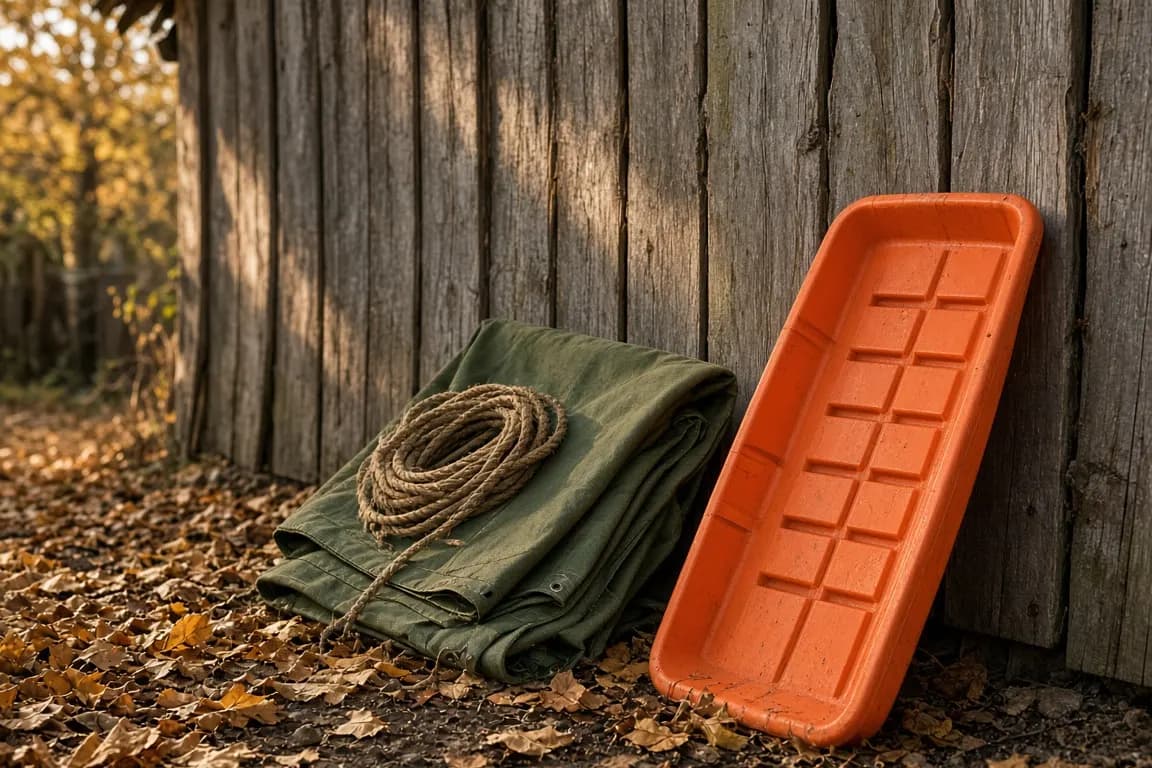
- A heavy-duty tarp (8 by 10 ft or larger) with grommets. Roll the animal onto it by tucking half the tarp under the back, then rolling the body toward you and pulling the tarp through. Tie rope through the front grommets to make a pull handle.
- A plastic sled or skid, like a deer or ice-fishing sled. It glides over grass, mud and snow far more easily than a tarp and keeps the body clean.
- A tractor or skid-steer bucket, lined with straw bales, old blankets or a folded tarp so the metal edge doesn't mark the body. Lower the bucket flat to the ground and slide the animal in rather than scooping.
- A loading ramp, or two sturdy planks, so a sled can be pulled up into a trailer or a truck bed with a rope rather than lifted.
- A blanket or sheet to wrap the animal for the journey. In a large US survey, 64% reject trash bag[2] of pet owners said a trash bag is not an acceptable container, and a simple blanket feels better to almost everyone.
- Gloves, boots and a change of clothes. Bodies can leak fluid when moved, particularly ruminants.
Bring the vehicle to the animal wherever you can, not the other way round. A few extra yards of driving on firm ground save a lot of dragging through a muddy gateway.
Loading up
Pickup bed, trailer or bucket: which vehicle works?
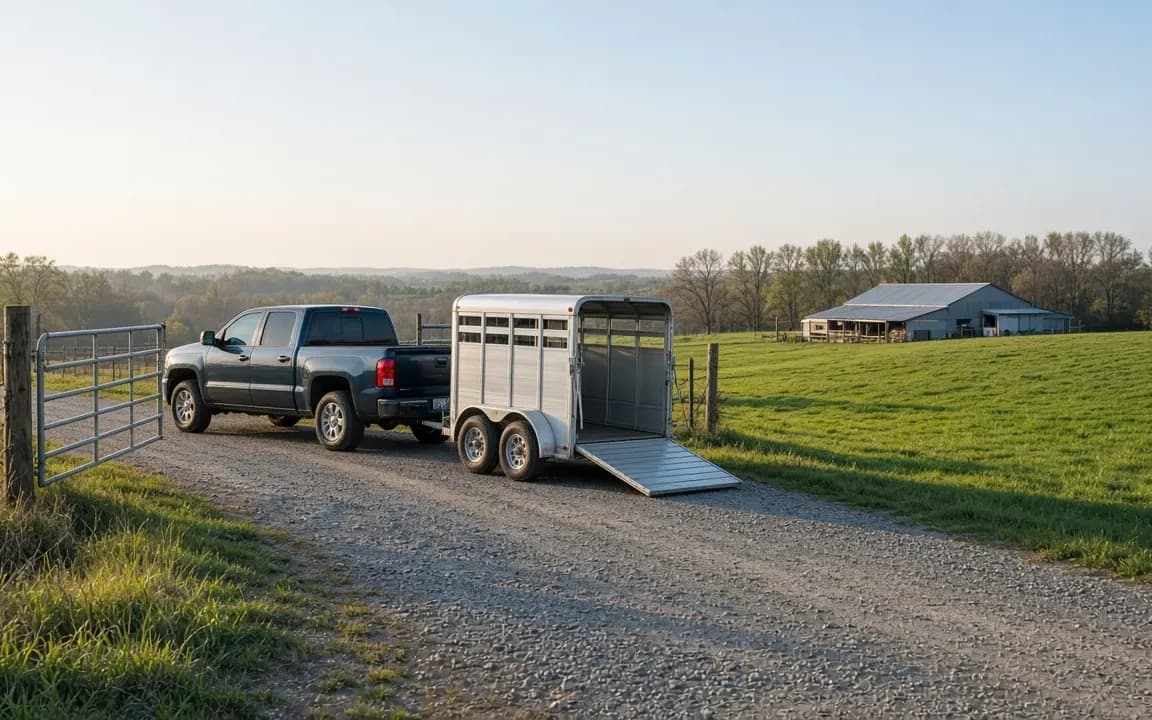
A standard pickup tailgate sits roughly two and a half to three feet off the ground, which is manageable for a 60 lb goat and punishing for a 200 lb pig. For anything over about 100 lb, a low stock trailer with a ramp or a tractor bucket is usually easier than a truck bed. If you only have a pickup, back it into a slope or a ditch edge so the tailgate is closer to ground level, and pull the sled up planks with a rope.
Lay a tarp in the bed or trailer first, then a layer of straw or old blankets, then the animal on its sled. Keep the body on its side, strap the sled so it can't slide on braking, and cover it for the drive. Nobody on the road needs to see what you're carrying, and a cover also keeps the sun off.
Call ahead before you drive anywhere. Ask the provider where to unload, whether they have a hoist or forklift, and what time someone will be there to help. The list of questions to ask a farm animal cremation provider covers the rest, and our guide to comparing written quotes shows how much delivering yourself can save against a collection fee.

Free tool
Cremation cost calculator
Estimate a realistic price range for your pet's size, location and the type of cremation.
Buying time
How do you keep the body cool until it can be moved?
Heat is the clock you're working against. Ruminants such as goats, sheep and alpacas keep fermenting feed after death, so they swell quickly on a warm day, and a well-covered pig holds heat for hours. Move the body out of direct sun as soon as you can, even if the proper move has to wait for help.
- Lay the animal on a tarp over concrete, gravel or earth in the shadiest place you can reach, never on a heat-holding surface like black rubber matting.
- Put frozen water bottles or bags of ice along the belly and between the legs, and replace them as they melt.
- Cover loosely with a light-colored sheet. Don't seal the body in plastic, which traps warmth.
- Keep dogs, cats and scavenging birds away. A stock panel propped over the body works well outdoors.
- In winter, cold helps you, but don't leave the animal where it can freeze into an awkward position if you'll need to move it on a sled later.
Timing rules vary by place. Pennsylvania expects disposal within 48 hours[3], and several California counties give owners 24-48 hours[4] before penalties apply. Our local pages summarize what applies where you live, and a cool, covered body gives you time to make the call calmly. The Pennsylvania rule is explained in Penn State Extension's disposal guide, and the California county limits in a UC ANR livestock mortality guide.
What was (or would be) hardest about the practical side?
Tap an answer to vote and see how others answered. Anonymous.
When DIY isn't right
Who can collect an animal from a muddy field or locked yard?
If the animal is large, the field is waterlogged, or the body is down a slope or behind a narrow gate, a collection crew is usually the safer choice. Many pet crematories that take farm species send a van or truck with a powered winch and a slide board, and some large-animal services arrive with a trailer and a hoist. Rendering and fallen-stock collectors also use winches, though nothing comes back from them; for comparison, rendering pickup for a whole horse typically costs $75-$200[5].
For a sense of scale, our estimate puts horse cremation at about $0.80/lb[6] at midpoint prices. Ask for the collection fee as its own line, then compare it with what hiring a trailer and two helpers would cost you.
Crews can only plan properly if they know what they're driving into. When you ask for collection, describe the access in detail:
- The exact spot where the animal lies, and the distance from the nearest place a vehicle can stop.
- Gate widths, padlocks and who has the key or code, plus any low branches or overhead wires.
- The ground: hard track, grass, deep mud, snow, or a steep bank.
- A pin or clear directions, because farm addresses often lead mapping apps to the wrong entrance.
- Whether you or anyone else can help on the day, and whether a tractor is available.
If you'd rather not make several calls, send us these details and we'll reply by email with providers who collect from farms in your area. Knowing whether you want private or communal cremation helps too; private vs communal cremation explains the difference.
Moving the body well is its own quiet act of care.
Afterwards
How do you clean the truck and trailer afterwards?
Clean the vehicle the same day. Hose out loose straw and bedding and put it in a sealed bag or burn barrel only where local rules allow; don't spread it where other animals graze. Scrub the bed or trailer floor with warm water and detergent, rinse, then apply a farm disinfectant at the label strength and leave it for the contact time the label gives.
Wash tarps and sled the same way, and let everything dry in the sun. Wash your gloves and boots, change your clothes, and wash your hands before you touch other animals, especially if the death was sudden or unexplained. If your vet suspects an infectious disease, ask for their advice before moving the body at all, since some cases need a necropsy or a report first.
Then give yourself a moment. Moving the body is often the hardest physical part of losing a farm animal, and it's normal to feel wrung out. When you're ready, ideas for a memorial corner on the farm can turn the spot where your animal lived into a place to remember them. If you're curious what other keepers found hardest on the day, see the poll results.

Reader polls
What would you choose?
Vote anonymously and see how other readers answered. The results are live counts from people who visit this site, so they show real opinions, not a scientific sample.
What was (or would be) hardest about the practical side?
Tap an answer to vote and see how others answered. Anonymous.
Where would you prefer your pet's final moments to happen?
Tap an answer to vote and see how others answered. Anonymous.
What surprised you most about the cost of pet aftercare?
Tap an answer to vote and see how others answered. Anonymous.


Questions people ask
Can I transport a dead goat in my car?
You can, if the goat is small and you protect the car well. Lay a waterproof sheet and old blankets in the trunk or rear area, wrap the goat in a blanket, and keep the air conditioning running. For anything larger than a pygmy or dwarf goat, a pickup or trailer is more practical and far easier to load without injury.
Do I need a permit to move a dead farm animal?
For a single pet animal driven to a crematory or vet, usually not in the US, but rules differ by state and during disease outbreaks movement can be restricted. If your vet suspects a reportable disease, they will tell you whether the body can move. In England, fallen stock should go through an approved collector or incinerator.
How long can a dead goat or sheep wait before it's moved?
In cool weather and shade, several hours or overnight is usually fine. On a hot day, ruminants bloat quickly and the body becomes much harder to handle, so aim to move or collect within the same day. Ice packs along the belly and a loose light cover buy extra time.
Will a cremation provider come into the field to collect?
Some will, if their vehicle can reach the animal safely. Others need the body at a gate or a hard track. Describe the access honestly when you ask, including mud, slopes and gate widths, and ask whether a winch or extra person is included or charged separately.
What if the animal is too heavy for us to move at all?
Don't try. Cover the body, keep it cool, and call a provider that collects large animals, a rendering or fallen-stock service, or a neighbor with a tractor and loader. A llama or donkey usually needs a winch or a bucket, and there's no shame in asking for help.
Should the rest of the herd see the body before it's moved?
Many keepers find that goats, alpacas and donkeys settle more quickly if a companion can sniff the body for a few minutes before it leaves. It isn't essential, but it's easy to allow while you gather equipment, and it may reduce calling and searching in the days after.


Sources and our estimates
- [1] State rules commonly require dead animals to be buried within 24 to 72 hours of death, especially when euthanized. Cornell Waste Management Institute & Penn State - Horse Mortality: Carcass Disposal Alternatives (2012), 2012.
- [2] 64% of US owners rated a trash bag as an unacceptable container for a deceased pet; 66.1% rated a blanket/shroud acceptable. Cooney, Kogan, Brooks, Ellis - Pet Owners' Expectations for Pet End-of-Life Support and After-Death Body Care, Topics in Companion Animal Medicine (2020), 2020.
- [3] Pennsylvania requires a dead domestic animal to be properly disposed of within 48 hours of death. Penn State Extension - Livestock and Poultry Mortality Disposal in Pennsylvania (J. Craig Williams, updated Oct 2025), 2025.
- [4] Several California counties give owners 24 or 48 hours to dispose of a dead animal before penalties apply. UC Cooperative Extension (Schohr, Lile, Snell) - Livestock Carcass Management, UC ANR 2021, 2021.
- [5] Rendering companies typically charge a pickup fee of $75-$200 to remove a horse carcass, depending on location. Extension Horses (eXtension national Cooperative Extension) - Horse Disposal Options, 2019, 2019.
- [6] Midpoint horse cremation cost works out to about $0.80 per pound of body weight, versus about $0.14 per pound for rendering pickup and $0.23 per pound for on-farm composting. Our estimate: cremation $800 / 1,000 lb; rendering $137.50 / 1,000 lb; composting $275 / 1,200 lb. How we calculate.
Find a provider who collects from farms
Tell us what you need and where you are. We'll reply by email with clear options and prices so you can decide in your own time.