Can you bury a pet pig on your own property?
In much of the US, yes, if you follow your state's depth, distance and timing rules; Michigan, for example, wants burial within 24 hours and at least 2 ft deep[1]. In England, a pig can't be buried at home at all.
By the Farm Animal Cremation Services editorial team · Updated September 24, 2026 · 5 min read · Sources
- US state rules, with examples
- How big the hole really is
- What to do if burial isn't allowed
The short answer
Is it legal to bury a pet pig in your yard?
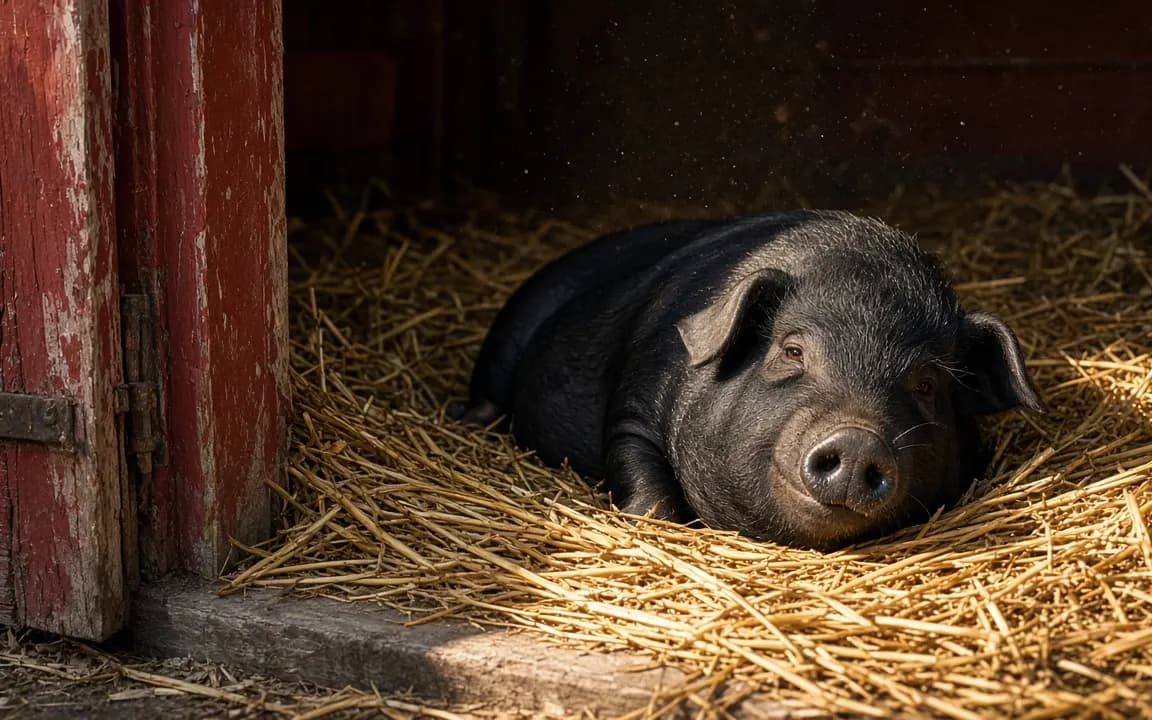
In most US states it's legal to bury a pig on land you own, as long as you meet the state's rules on depth, distance from water and property lines, and how quickly the body is buried. Towns, counties and homeowners' associations can be stricter than the state. In England it isn't allowed: pigs count as farmed animals even when they live indoors as pets, so the body must go to an approved collector or incinerator.
The law usually doesn't care that your pig had a name and a bed by the stove. Pigs are a livestock species, and disposal rules were written with disease control and groundwater in mind. That's the starting point for everything below, and it's why a dog owner's rules often don't apply to you.
Before today, did you know the burial rules for farm species where you live?
Tap an answer to vote and see how others answered. Anonymous.
State by state
What do US state rules actually require?
There is no national rule, but most states share the same three ingredients: a deadline, a minimum soil cover and minimum distances from water. Three examples show how much they vary.
| State | Deadline | Depth and distances | Worth knowing |
|---|---|---|---|
| Pennsylvania | 48 hours[2] | 2 ft of soil cover; 2 ft above bedrock and seasonal high water; 100 ft from wells, waters and property lines[3] | 200 ft from wells is recommended |
| Michigan | 24 hours | At least 2 ft deep; not within 200 ft of a well[1] | Limits on burial sites per acre |
| California | Often 24-48 hours by county[4] | Subject to regional water board rules | Burial on your land is allowed within 3 miles[5] of where the animal died; composting whole mammals is banned |
Setbacks are where suburban lots fail. A 100 ft distance from every property line, as Pennsylvania requires, rules out burial on most half-acre and many one-acre lots before you even think about wells. Check your own state and county on our location pages, and call the county extension office if the wording is unclear. England is stricter still: its 50 m well setback for a buried horse works out to about 164 ft[6] by our conversion, and pigs there can't be buried at all. Penn State Extension's disposal guide has the full Pennsylvania conditions.
If you're in the UK
Why can't you bury a pet pig in England?
England has a ban on livestock burial[7], and pigs, sheep and goats kept as pets are still treated as farm animals for this purpose. Horses are the exception, and donkeys count as equids, but pet pigs are not. Instead, the body has to take one of 5 approved routes[8], which include renderers, incinerators and knackers' yards, and most keepers book collection through the National Fallen Stock Company. GOV.UK's fallen stock guidance lists them.
A licensed pet crematorium that accepts pigs is one of those incinerator routes, which is how UK owners bring a pig's ashes home legally. Scotland and Wales have their own rules, so check with your local animal health office.
Two hidden risks
Is it safe to bury a pig that was euthanized?
Only if the grave is deep and secure. The barbiturates used to put animals to sleep stay in the body for a long time, and a dog, fox, coyote or eagle that digs up and eats the remains can be poisoned. Since 2003[9], US euthanasia drug labels have warned that treated animals must be buried deeply, incinerated or disposed of another approved way. A 2 ft soil cover may meet the law but not stop a determined dog; many owners add a layer of heavy stone or a buried stock panel over the body.
Disease is the second risk. African swine fever has never been found in the US, but it has spread across Asia and Europe and reached the Caribbean, and it would be a notifiable emergency here. Classical swine fever and foot-and-mouth disease are also reportable. If your pig died suddenly with fever, blotchy red or purple skin, bleeding or breathing trouble, or if several pigs are sick, call your vet before burying or moving the body. Most pet pig deaths are nothing of the sort, but that call protects every pig near you.
The practical reality
How big a hole does a pig really need?
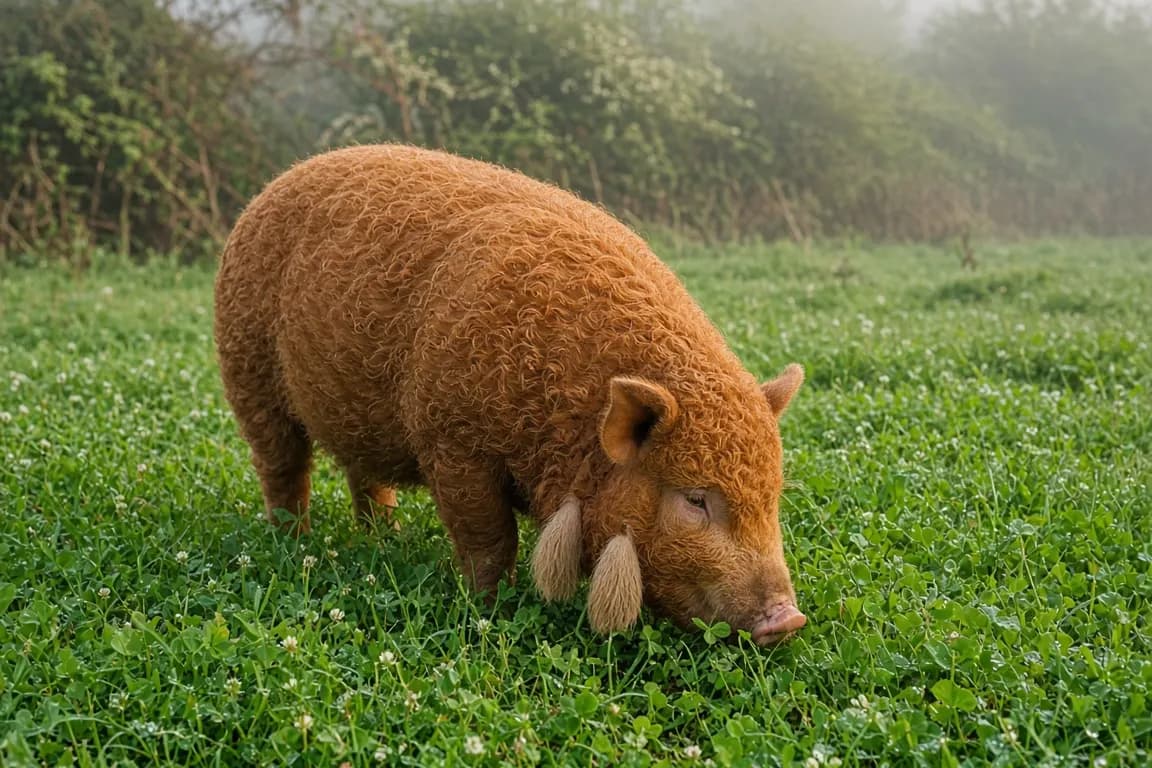
Bigger than people picture. Pot-bellied and kunekune pigs commonly weigh 100 to 250 lb as adults, and a farm breed that grew up as a pet can pass 500 lb. Pigs are dense and wide, so the grave has to fit the body lying on its side plus the full soil cover your state requires on top.
Say you have a 180 lb pot-bellied pig about 3 ft long. With room to lay them down gently and 2 ft of cover, you need a hole roughly 4 to 5 ft long, 3 ft wide and 4 ft deep. That's around 50 to 60 cubic feet of soil, which weighs several tons. By hand it's a full day's work for two people in easy ground, and rock or clay can make it impossible.
- Call 811 (the US dig-safe line) a few days before digging to have buried cables and pipes marked.
- Hire help if needed. Backhoe rental for a large animal runs about $250-$500[10], which puts it close to the cost of cremation for some pigs.
- Choose the spot with care: away from the vegetable garden, wells, septic lines and any slope that drains toward water.
- Wrap the body in a cotton sheet or blanket rather than plastic, and fill the hole the same day.
Getting a heavy pig to the grave is often harder than digging it. Our guide to transport and logistics covers sleds, ramps and tractor buckets.
If burial is out
What are the alternatives to burying your pig?
If the rules, the ground or the risks rule burial out, you still have kind choices. Many pet crematories take pigs up to a few hundred pounds, and some large-animal crematories take far bigger. Our services page covers each route; this is how they compare for a pig.
- Private cremation: your pig alone, ashes returned. A 200 lb pig produces a substantial amount of ash, enough to bury some in a favorite rooting spot, which is almost always allowed.
- Communal cremation: no ashes back, much lower cost. Private vs communal cremation explains the difference.
- Fallen-stock or rendering collection: cheap and quick, but industrial, and nothing returns.
- Composting: legal in some states, banned for whole mammals in California, and slow for a big pig. Our post on eco-friendly aftercare weighs it honestly.

Free tool
Aftercare options compared
Compare private, communal and water cremation with burial on cost, timing and what comes home.
The aftercare options comparison ranks these by cost, legality and what matters to you. Whichever you choose, a marker or planting can still mark where your pig loved to lie; see outdoor pet memorials for pig-proof ideas if you have others still rooting.
Where the body goes and where you remember them don't have to be the same place.
If you'd like cremation prices to weigh against the cost of digging, tell us your pig's weight and area and we'll reply by email with options. Wondering whether other keepers knew about the rules? The burial-rules poll is on our results page.

Reader polls
What would you choose?
Vote anonymously and see how other readers answered. The results are live counts from people who visit this site, so they show real opinions, not a scientific sample.
Before today, did you know the burial rules for farm species where you live?
Tap an answer to vote and see how others answered. Anonymous.
If you had to decide today, which aftercare would you choose for your pet?
Tap an answer to vote and see how others answered. Anonymous.
Where are (or will be) your pet's ashes?
Tap an answer to vote and see how others answered. Anonymous.


Questions people ask
How deep should I bury a pot-bellied pig?
Deep enough to give at least the soil cover your state requires over the top of the body, commonly 2 ft, and more if your pig was euthanized or you have dogs or coyotes nearby. In practice that means a hole around 4 ft deep for a medium pot-bellied pig. England requires at least 1 m of cover[11] for pets it allows, but pigs aren't among them.
Can I bury my pig's ashes instead of the body?
Almost always, yes. Cremated remains are sterile and carry none of the drug or disease concerns of a body, so the depth and setback rules don't apply in the same way. Mix the ashes into soil rather than leaving them in a lump, since they are very alkaline.
Does a pet pig count as livestock?
Legally, usually yes. Most US states and the UK treat pigs as livestock regardless of whether they live in a barn or a house, which is why disposal rules, and sometimes movement and ownership rules, apply. Some cities treat miniature pigs as pets for zoning, but that rarely changes disposal law.
What if my pig died in winter and the ground is frozen?
You may not be able to dig within your state's deadline. Keep the body cold and secure from scavengers, and call a crematory or collection service. Some owners with space store the body in a cold outbuilding briefly, but check your state's timing rule first.
Can I be fined for burying a pig illegally?
Yes. States and counties can fine owners for improper disposal, especially near water or wells, and in England improper disposal of fallen stock is an offense. More practically, a shallow grave that is dug up by dogs or found by a neighbor tends to bring complaints fast.
How much does it cost to cremate a pet pig?
It depends mostly on weight and collection distance. Smaller pot-bellied pigs often fall in a crematory's large-dog price band, while pigs of several hundred pounds need a provider with a big enough chamber and cost more. Ask for a written, itemized quote that states the weight band.


Sources and our estimates
- [1] Michigan requires dead animals to be buried within 24 hours, at least 2 feet deep and not within 200 feet of a well, with no more than 100 burial sites or 10,000 lb of animals per acre. Michigan Farm News (Michigan Farm Bureau) - MDARD reminder: Animal burial options, 2024.
- [2] Pennsylvania requires a dead domestic animal to be properly disposed of within 48 hours of death. Penn State Extension - Livestock and Poultry Mortality Disposal in Pennsylvania (J. Craig Williams, updated Oct 2025), 2025.
- [3] Pennsylvania on-farm burial requires at least 2 feet of soil cover, 2 feet of clearance above bedrock and the seasonal high water table, and at least 100 feet from wells, sinkholes, waters and property lines (200 feet recommended). Penn State Extension - Livestock and Poultry Mortality Disposal in Pennsylvania (J. Craig Williams, updated Oct 2025), 2025.
- [4] Several California counties give owners 24 or 48 hours to dispose of a dead animal before penalties apply. UC Cooperative Extension (Schohr, Lile, Snell) - Livestock Carcass Management, UC ANR 2021, 2021.
- [5] California prohibits composting of unprocessed mammalian tissue such as cattle, goats and sheep (14 CCR 17855.2); owners may bury routine livestock mortality on their property within 3 miles of where the animal died, subject to regional water board rules. UC Cooperative Extension (Schohr, Lile, Snell) - Livestock Carcass Management, UC ANR 2021, 2021.
- [6] England's 50 m well setback for burying a horse equals about 164 feet, 1.6 times Pennsylvania's 100-foot minimum setback from wells. Our estimate: 50 m x 3.2808 ft/m; 164 / 100. How we calculate.
- [7] England bans the burial or open burning of fallen farm stock, but pet animals may be buried, and England (unlike Scotland and Wales) allows burial of both pet and non-pet horses. GOV.UK (Defra/APHA) - Fallen stock guidance, 2024.
- [8] England's approved routes for fallen stock are knackers, hunt kennels, maggot farms, incinerators and renderers; the not-for-profit National Fallen Stock Company runs collections for farmers and horse owners. GOV.UK (Defra/APHA) - Fallen stock guidance, 2024.
- [9] Since 2003 the FDA has required euthanasia drug labels to warn that euthanized animals must be disposed of by deep burial, incineration or another approved method to keep scavenging wildlife from eating the carcass. Cornell Waste Management Institute & Penn State - Horse Mortality: Carcass Disposal Alternatives (2012), 2003.
- [10] Renting a backhoe to bury a horse costs roughly $250-$500, and horse disposal in a landfill (where accepted) costs about $80-$150. Extension Horses (eXtension national Cooperative Extension) - Horse Disposal Options, 2019, 2019.
- [11] England's groundwater guidance asks for at least 1 m of clearance between the bottom of the burial hole and the water table, and at least 1 m of soil over the carcass, for larger animals and other animal burials; it sets no minimum requirements for small pets such as a dog or cat buried on your own land. GOV.UK (Environment Agency) - Animal burials: prevent groundwater pollution, 2024.
Compare burial with cremation near you
Tell us what you need and where you are. We'll reply by email with clear options and prices so you can decide in your own time.